Starship Launched: SpaceX's First Orbital Test
SpaceX launches Starship for its first orbital test: aiming for 275 km altitude, carrying 26 Starlink satellites, six orbits in ~10 hours, with splashdown in the Pacific.
Meta description: SpaceX launches Starship for its first orbital test: aiming for 275 km altitude, carrying 26 Starlink satellites, six orbits in ~10 hours, and splashdown in the Pacific.
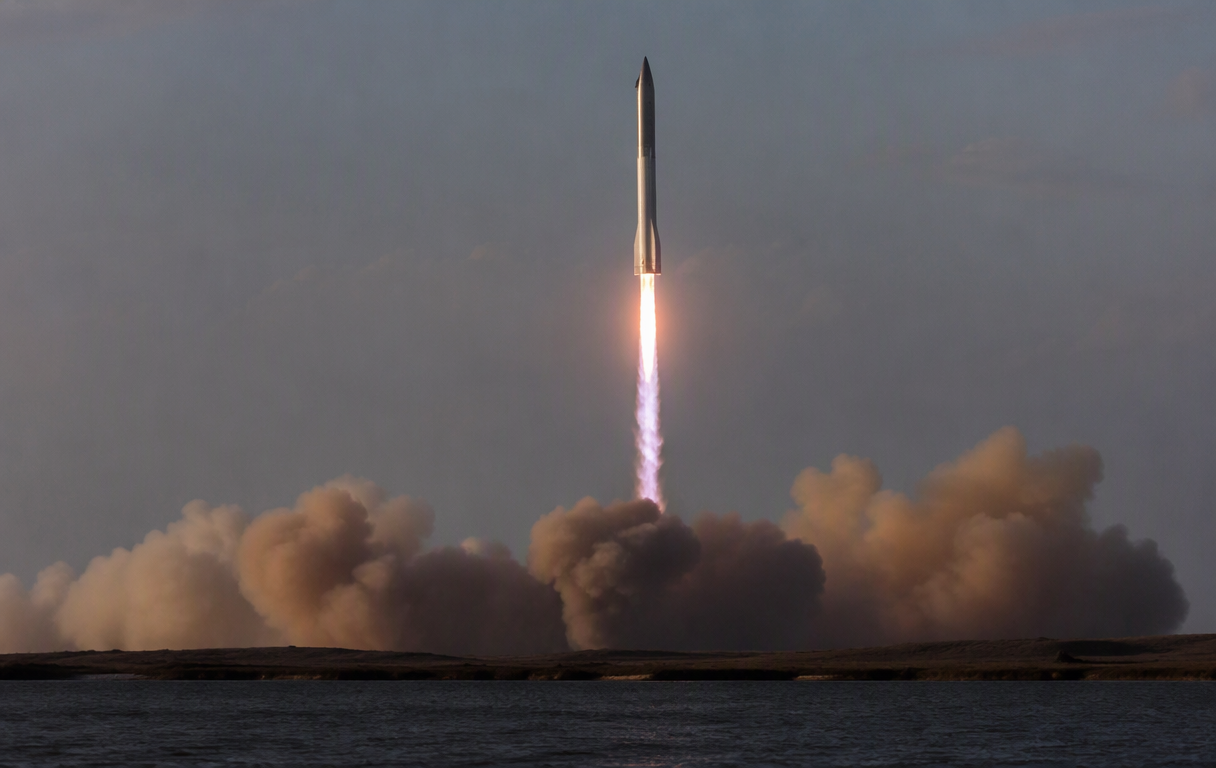
Starship was launched this Monday for SpaceX's first orbital test, following a series of 13 suborbital development flights, in a test that combines the Super Heavy booster and the Ship spacecraft, according to ANSA.
Launch Summary — Starship, SpaceX and Super Heavy
The launch marks the inaugural attempt to put the Starship system into orbit: the launch stack consists of the Super Heavy booster (first stage) and the Ship spacecraft (second stage), both designed by SpaceX. According to ANSA, this is the vehicle's first orbital test, following 13 suborbital flights that preceded this mission.
The test was conducted from SpaceX's launch facilities in Texas, with mission and telemetry teams monitoring engine performance, stage separation, and launch operations at all phases of flight, from liftoff to orbital insertion, as reported by ANSA.

Objectives and mission profile — orbit, 275 km, and Starlink payload
The primary technical objective of the flight is to reach orbit for the first time, with a reference altitude of 275 km, validating the propulsion, guidance, and thermomechanical systems of the second stage. The mission also carries an operational payload: 26 real Starlink satellites, which will be released in orbit for testing within SpaceX's satellite internet constellation, according to ANSA.
The release of the 26 satellites will serve both to validate payload separation mechanisms and to temporarily augment the Starlink constellation, whose expansion is strategic for connectivity services in remote areas. The presence of these satellites in a real orbital test allows assessment of interference, comms links, and orbital management procedures.
Duration and recovery — six orbits and splashdown in the Pacific
The mission has a predicted profile of six orbits around the Earth, with a total duration of approximately 10 hours. At the end of the orbital phase, the spacecraft is expected to perform reentry maneuvers and complete the flight with a splashdown in the Pacific Ocean, where recovery teams will monitor the area for data collection and any recoverable components, according to ANSA.
The goal of multiple orbits in an initial test is to evaluate thermal stability, propellant usage for orbital adjustments, and repetition of critical maneuvers under real conditions. SpaceX typically uses this type of mission to accumulate operational data before more regular flight routines.
Relevance for Brazilians and Italian descendants — connectivity and scientific interest
The test has global importance and potential impact for Brazilians and Italian descendants interested in science, technology, and communications. The expansion of the Starlink constellation could influence connectivity options in rural and remote areas of Brazil, as well as creating opportunities for collaboration and employment in satellite and telecommunications supply chains.
Additionally, the technological advancement demonstrated by the Starship program — with a focus on reusability and high payload capacity — opens possibilities for future scientific and commercial missions that could carry experiments, sensors, or payloads contracted by Brazilian universities and companies. Readers following technology and life abroad topics can follow developments and technical analyses in sections like Notícias da Itália and content on Vida na Itália at Raízes Italianas.
Context and next steps
If the orbital test is successful, SpaceX will have validated crucial milestones to make Starship operational in commercial and interplanetary flights, including potential lunar and Martian missions in the future. Meanwhile, the release of Starlink satellites will allow the company to collect real orbital operation data.
The scientific community and industry observers will monitor official telemetry reports and SpaceX statements, as well as analyses from specialized vehicle experts detailing engine performance, structural integrity, and splashdown recovery. For updates on related technology and science developments, readers can check our pages of Notícias da Itália and Cidadania Italiana for institutional topics intersecting the international agenda.
Source: ANSA.