Crater the size of a stadium on Dimorphos, asteroid deflected
ESA's Hera confirmed a large crater on Dimorphos and chaotic rotation after the 2022 DART impact; Milani and Juventas cubesats contributed observations.
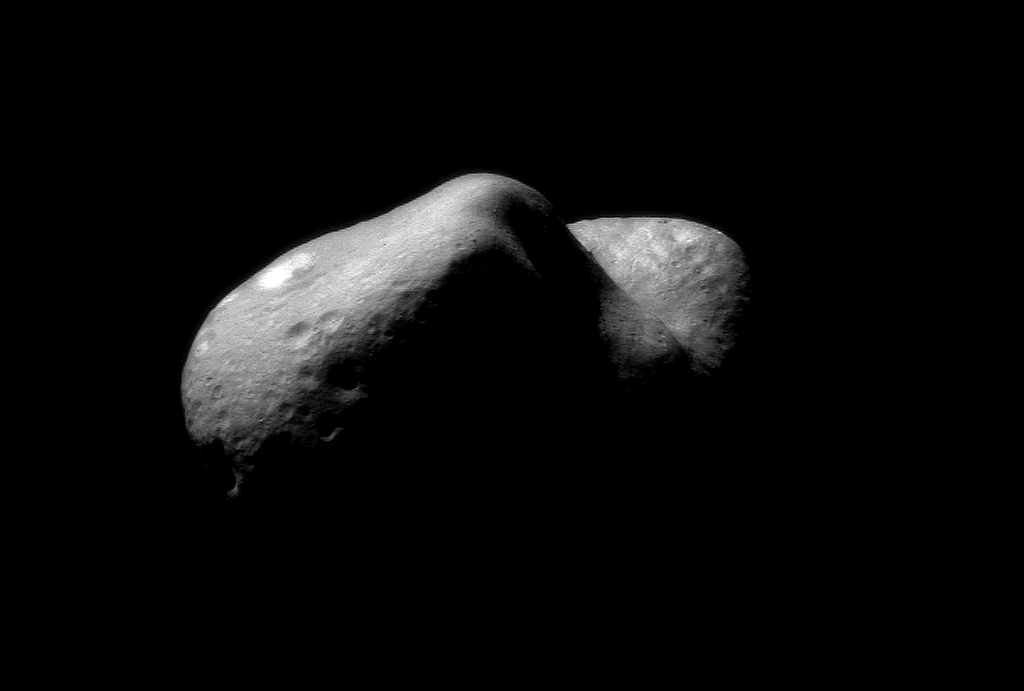
The ESA's Hera mission confirmed the existence of a crater the size of a stadium on Dimorphos and observed a chaotic rotation of the asteroid after the DART mission impact in 2022, in addition to thousands of rocky blocks on its surface, according to ANSA. The observations were complemented by the cubesats Milani (Italy) and Juventas (Luxembourg).
Meta description: Hera confirmed a large crater on Dimorphos and chaotic rotation after the 2022 DART impact; Milani and Juventas cubesats contributed observations.
Summary of findings: Dimorphos, crater and chaotic rotation
The Hera mission team detected in Dimorphos a large crater, described as comparable in size to a stadium, resulting from the changes induced by the 2022 DART impact. In addition to the central notch, instruments recorded a surface composed of hundreds of rocky blocks and a destabilized rotation around the primary body, Didymos — characterized by the team as chaotic rotation. These results were publicly announced during the official briefing, as reported by ANSA.
Missions and observations: Hera, DART, Milani and Juventas
The deliberate impact of NASA's DART (Double Asteroid Redirection Test) mission in 2022 aimed to modify the orbit of the satellite Dimorphos around the larger asteroid Didymos as a test of planetary defense. The confirmation of physical changes to the asteroid came with the arrival of ESA's Hera mission, which conducted detailed mapping and in situ measurements.

- Hera carried two cubesats that provided complementary observations: Milani, with Italian involvement, and Juventas, developed by a Luxembourg consortium. According to ANSA, the cubesats were essential for approach imagery and for characterizing the surface and internal structure of Dimorphos.
- The imagery and data allowed identification of the principal crater and mapping of the debris field — essential information for assessing the 2022 impact effect and calibrating risk-mitigation models for impactors.
The official announcement of the findings was made in the Hall of Dinosaurs at the Berlin Natural History Museum, with simultaneous events in cities like Milan and Rome, where scientific teams and representatives from space agencies commented on the results, according to ANSA coverage.
Context and relevance: planetary defense and European involvement (including Italian)
The DART-Hera project integrates an international research program in planetary defense, whose goal is to test techniques capable of deflecting potentially hazardous asteroids before they reach Earth — a strategy inspired by the risk that led to the dinosaurs' extinction 66 million years ago. Hera's confirmation of a large crater and dynamic changes in Dimorphos provides real data to validate numerical impact models and the mechanical responses of small bodies to a kinetic collision.
For the European scientific community and for Brazil, these results have practical and symbolic implications:
- The presence and role of the cubesat Milani, with Italian contribution, highlight Italy's industrial and scientific capabilities in cutting-edge space missions, information relevant to readers interested in European science and technology.
- The data help improve international protocols for detection, monitoring, and response to near-Earth objects (NEOs), with implications for formulating global planetary protection strategies — a topic of interest for governments, research centers and the general public.
Brazilian readers of Italian descent can follow the developments of Italian involvement in European missions and their impact on applied science, alongside related national and international topics in scientific cooperation. For more context on Italian science and current events, coverage continues in our Italy News. Topics on life and work tied to the Italian presence in science are also within the scope of Life in Italy. For readers seeking practical information about ties with Italy beyond science, check our pages on Italian Citizenship.
What comes next: investigation and modeling
With Hera and cubesats data, international teams will:
- Refine models of the mechanical response of asteroids to kinetic impacts.
- Study the rotational stability of small bodies with fragmented surfaces.
- Assess debris accumulation and its impacts on the effectiveness of deflection techniques.
These steps are essential to turn isolated tests into operational protocols, should a threatening asteroid be detected with enough lead time for intervention.
Conclusion The confirmation of the large crater and chaotic rotation in Dimorphos by the Hera mission, with contributions from the Milani and Juventas cubesats, represents a concrete advance in validating planetary defense techniques and highlights European scientific cooperation — including Italian participation — on a topic of global interest, per ANSA.
Source: ANSA